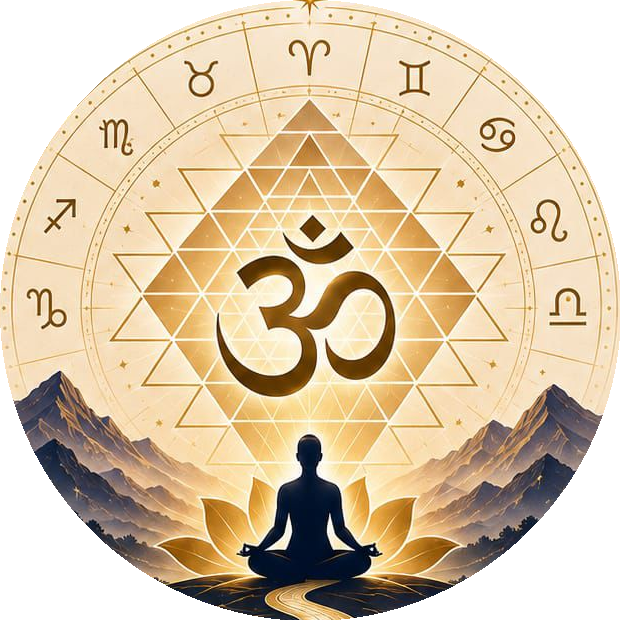
We spend our entire lives saying “I.” I am happy. I am angry. I am successful. I am hurt. I am afraid. I am this body, this profession, this relationship, this personality, this history. But have we ever stopped to ask what this “I” really is? Beneath everything we have been told about ourselves, beneath our name, our achievements, our memories and even our thoughts, who are we? This question is not merely philosophical. It is the beginning of the inner journey, and it lies at the heart of Atmabodha—the knowledge of the Self.
One of the most profound teachings of Vedanta is that the mind is not the Self. This can sound simple, but contemplating it deeply can change the way we experience life. We know that our thoughts change. Our emotions change. Our opinions change. Our body changes. Even our sense of identity changes as we move through childhood, adulthood and old age. Yet there is something that remains aware of all these changes. There is a presence that knows when the mind is happy, when it is disturbed, when a memory arises and when a thought disappears. If something can be observed, Vedanta invites us to ask: Can that which is being observed be the ultimate observer?
01. Antahkaran: The Four Functions of the Inner Instrument
This is where the ancient understanding of Antahkaran, the inner instrument, becomes important. The Antahkaran is not the Atman. It is the subtle mechanism through which our inner experience takes place. It is commonly understood through four functions—Manas, Buddhi, Ahankaar and Chitta. These are not four separate physical organs but different functions of the inner instrument.
Manas is the aspect that receives impressions, considers possibilities and constantly moves between alternatives. It is the mind that wonders, doubts, imagines and reacts. Someone sends us a message saying, “We need to talk,” and within seconds Manas can create ten different possibilities. Is something wrong? Did I make a mistake? What happened? What are they going to say? Nothing has actually happened, yet the mind has already travelled into several possible futures.
Then comes Buddhi, the faculty of discernment. Buddhi asks a different question: What is actually true? Manas creates possibilities; Buddhi examines them. Manas reacts; Buddhi discriminates. This is why the cultivation of Vivek, or discernment, is so important on the spiritual path. Not every thought that appears in the mind deserves to be believed, and not every emotion deserves to become an action.
Then there is Ahankaar, the sense of “I.” Ahankaar takes an experience and attaches it to identity. There is anger, and suddenly it becomes “I am angry.” There is failure, and it becomes “I am a failure.” Someone criticises us, and we experience it as “They have attacked me.” Ahankaar is necessary for functioning in the world; we need an individual identity to perform our responsibilities. But the difficulty begins when the functional identity becomes our entire understanding of who we are.
We begin to believe that we are our profession, our relationships, our possessions, our reputation, our achievements, our failures and our memories. We even begin to say, “This is my horoscope; this is my karma; this is who I am.” But the horoscope describes the field of experience—it does not exhaust the Self.
And then we come to Chitta. Chitta is associated with the deeper field of memory, impressions and mental tendencies. Experiences leave impressions, and those impressions influence the way we respond to future experiences. Sometimes we react strongly to something without understanding why. A particular word, situation or relationship can awaken an emotion that seems much larger than the present moment. Something from the past is still influencing the present.
This is the world of Sanskaar—the impressions and tendencies formed through experience. What we repeatedly think, feel and do can strengthen patterns within us. Those patterns influence our behaviour, our behaviour creates further experiences, and the cycle continues.
This is why we sometimes find ourselves repeating the same story with different people, in different places and at different stages of life.
The spiritual journey begins when we become curious about that pattern instead of simply blaming the circumstances.
02. This is also where Jyotish can become much more than a system of prediction. A birth chart can reveal tendencies, patterns, strengths, challenges and karmic themes. The Moon can tell us much about the movement of the mind; Mercury about discrimination and processing; Saturn about responsibility and endurance; Rahu about desire and fascination; Ketu about detachment and withdrawal. But the Grahas are describing the movement of experience. They are not describing the entirety of the Self.
This distinction is crucial. If the Moon is disturbed, we may experience a disturbed mind. But we are not the disturbance.
If Saturn brings limitation, we may experience difficulty. But we are not the difficulty.
- ✦ If Rahu creates intense desire, we may experience obsession. But we are not the obsession.
- ✦ If Ketu creates detachment, we may experience separation. But we are not the separation.
- ✦ The deeper question is always: Who is aware of all this?
- ✦ This is the doorway to the Shakshi—the Witness.
- Meditation begins to reveal this in a very simple way. We sit quietly and try to observe the breath, and immediately the mind begins to wander. A memory appears. A plan appears. A fear appears. A sound appears. An emotion appears. For a moment, we are carried away by it. Then we realise, “I was thinking.”
That moment is extraordinarily important.
Because if you can recognise that you were thinking, there must be an awareness of the thought.
The thought came.
The thought remained for a while.
The thought disappeared.
But awareness knew all three stages.
This is the beginning of recognising that you are not every thought that passes through your mind.
03. The Nirvana Shatakam: The Sacred Negation
One of the most beautiful expressions of this understanding is found in the Nirvana Shatakam, traditionally attributed to Adi Shankaracharya. The hymn is not simply telling us what the Self is. It approaches the Self through a powerful process of negation—removing everything that we habitually mistake for ourselves.
It begins:
न च व्योम भूमिर्न तेजो न वायुश्चिदानन्दरूपः शिवोऽहम् शिवोऽहम्॥
“The meaning is profound: I am not the mind, intellect, ego or memory; I am not the senses; I am not earth, water, fire, air or space. I am of the nature of pure consciousness and bliss—I am Shiva.”
Notice where the hymn begins. Manas. Buddhi. Ahankaar. Chitta. The very components of the inner instrument we have been discussing.
It is almost as if the seeker is being asked to stand back and observe the entire Antahkaran and say:
The hymn continues its journey by releasing identification with the senses, the elements, the vital forces, the bodily functions and even the ordinary categories of relationship and identity. It eventually declares:
न धर्मो न चार्थो न कामो न मोक्षश्चिदानन्दरूपः शिवोऽहम् शिवोऽहम्॥
“I am not hatred or attachment, greed or delusion, pride or jealousy. I am not defined by Dharma, Artha, Kama or even Mokṣha. I am pure consciousness and bliss—I am Shiva.”
This is an astonishing teaching. Even the spiritual identity of “I am seeking Moksha” is eventually something to be transcended. The seeker must ultimately go beyond every label.
This does not mean that Dharma, Artha, Kama or Moksha are meaningless. They are fundamental dimensions of human life. Rather, the hymn is pointing toward that which exists before and beyond every identity we construct around ourselves.
This is why the Nirvaṇa Shatkam can be such a powerful companion to the study of Antahkaran.
It does not ask us to destroy the mind.
It asks us to stop mistaking the mind for the Self.
The mind remains necessary. Buddhi remains necessary. Ahankaar remains necessary for functioning. Chitta continues to hold impressions. We still have relationships, responsibilities, desires and experiences. But our relationship with all of them can change when we recognise that they are objects of awareness rather than the ultimate subject.
04. The Shift in Perception: You Are Not the Weather
This is a subtle but transformative shift.
- ✦ Instead of saying, “I am anxious,” we can begin to notice, “Anxiety is present in the mind.”
- ✦ Instead of saying, “I am angry,” we can observe, “Anger is moving through the mind.”
- ✦ Instead of saying, “I am a failure,” we can recognise, “The mind is interpreting an experience as failure.”
The experience is not denied. The emotion is not suppressed. But identification becomes lighter. And when identification becomes lighter, freedom begins to appear.
Perhaps this is also why spiritual growth is not simply about making the mind positive all the time. A positive thought is still a thought. A negative thought is still a thought. Both arise and disappear. The deeper journey is to recognise the awareness in which both appear.
This understanding also transforms our relationship with astrology. Jyotish can tell us about the weather, but it does not tell us that we are the weather. A difficult planetary period may bring storms; a favourable period may bring sunshine. But neither storm nor sunshine is the sky itself.
Karma expresses itself. • Life changes.
✦ But the witnessing consciousness remains. ✦
This does not mean that we become indifferent to life. In fact, the opposite can happen. When we are less imprisoned by our identities, we can participate in life more fully. We can fulfil our responsibilities without allowing every success to inflate us or every failure to destroy us. We can love without needing to possess. We can act without being completely consumed by the result.
This is where Dharma and Moksha begin to meet. We live in the world, but we gradually learn that we are more than the roles we perform within it.
05. Perhaps this is the deeper meaning behind the journey of Shri Moksham.
It begins with knowing the outer world—our circumstances, tendencies, planets and Nakshatras. It then turns toward the inner world—Manas, Buddhi, Ahankaar and Chitta. But it does not stop there.
The final movement is inward toward the one who witnesses all of them.
The Nirvana Shatkam answers not by giving us another identity to hold onto, but by removing the identities we have mistaken for ourselves.
“I am of the nature of consciousness and bliss. I am Shiva.”
Not Shiva merely as a figure standing outside us, but Shiva as the auspicious, pure consciousness toward which the seeker is ultimately directed.
- ✦ The mind is an instrument.
- ✦ Chitta carries impressions.
- ✦ Manas moves.
- ✦ Buddhi discriminates.
- ✦ Ahankaar creates the sense of individuality.
- ✦ But the Self is the light by which all of them are known.
And perhaps the first step toward liberation is not controlling that light, but simply recognising it.
That recognition is not the end of the spiritual journey.
It is where the journey truly begins.
“I am not the mind, intellect, ego or memory; nor am I the ears, tongue, nose or eyes; nor am I sky, earth, light or wind. I am the form of pure consciousness and bliss—I am Shiva, I am Shiva. (Adi Shankaracharya, Nirvana Shatakam Verse 1)”