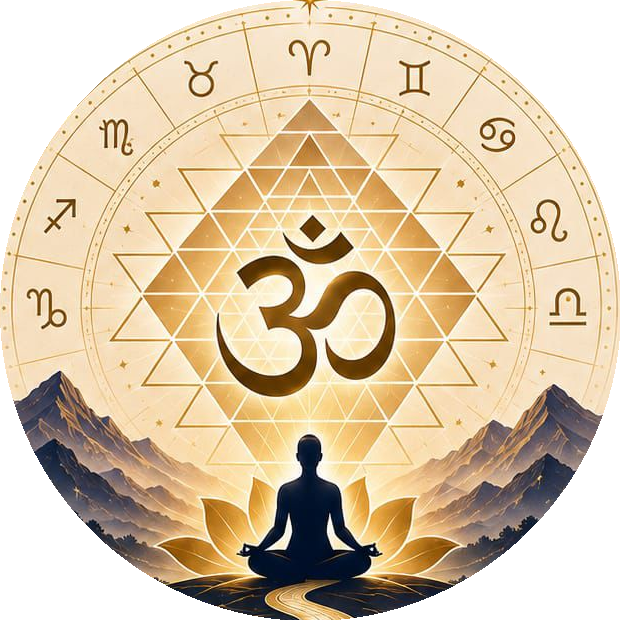
In Jyotish, we often look at a horoscope and immediately begin searching for remedies. Saturn is troubling a house, Rahu is creating confusion, Mars is causing conflict, the Moon is disturbed, a particular Nakshatra is under pressure—and naturally, we ask: What should I do to correct it?
But there is a much deeper question: What if, instead of trying to remedy every planet separately, we connect ourselves with the consciousness that exists beyond all the planets?
01. The Grahas are part of a larger cosmic order
In Jyotish, we often look at a horoscope and immediately begin searching for remedies. Saturn is troubling a house, Rahu is creating confusion, Mars is causing conflict, the Moon is disturbed, a particular Nakshatra is under pressure—and naturally, we ask: What should I do to correct it?
But there is a deeper question.
What if, instead of trying to remedy every planet separately, we connect ourselves with the consciousness that exists beyond all the planets?
This is where the Vishnu Sahasranama holds a special place.
The Vishnu Sahasranama is the sacred hymn of the thousand names of Vishnu, taught by Bhishma to Yudhishthira in the Mahabharata. Bhishma presents the thousand names as a means of praising the Supreme and attaining the highest good.
From a Jyotish perspective, this is profound because the Grahas are not independent powers operating outside the cosmic order. They represent forces through which Karm, Kaal, experience and consciousness express themselves.
So when we worship the Supreme, we are not merely asking Saturn to become kind, Rahu to disappear, or Mars to stop creating problems. We are cultivating a consciousness that allows us to experience the same planetary Karm differently.
02. Instead of thinking, “My Saturn is causing this,” we begin to ask:
Jyotish teaches us to observe the relationship between the individual and the cosmos. The Sun represents consciousness and vitality; the Moon represents the mind; Mars represents action and courage; Mercury represents intellect; Jupiter represents wisdom; Venus represents desire and value; Saturn represents time, responsibility and Karm; while Rahu and Ketu represent the shadow, desire, detachment and karmic patterns.
The planets indicate the field in which our Karm unfolds.
But Vishnu represents something much larger.
One of the opening names of the Sahasranama is Vishvam — the Universe itself. Another is Vishnuh — the all-pervading one. The hymn then describes Him as Bhuta-bhavya-bhavat-prabhuh — the Lord of the past, present and future.
This immediately changes the way we look at planetary remedies.
“What is Saturn teaching me?”
Instead of, “Why is Rahu destroying my peace?”, we ask:
“What desire is Rahu revealing?”
03. Why one Stotra can address many Grahas
Instead of, “Why is my Moon disturbed?”, we ask:
“What is my mind attached to?”
The horoscope tells us where the lesson is. Spiritual practice helps us develop the consciousness with which we meet that lesson.
04. Vishnu and Saturn — learning to surrender to Kaal
Traditional Jyotish remedies often prescribe specific mantras, charities, deities, colours, fasting or rituals for individual planets. These can have their place within a personalised remedial approach.
But the Vishnu Sahasranama works at another level.
Its thousand names do not describe only one quality of the Divine. They describe existence through countless dimensions—consciousness, time, creation, preservation, knowledge, action, sacrifice, protection, dissolution, liberation and more.
That is why it can be understood as a holistic spiritual remedy.
The Sahasranama contains names such as:
Aatma — the SelfParamatma — the Supreme SelfShakshi — the WitnessKshetrajna — the Knower of the fieldKaal — TimeYajna — SacrificeYoga — UnionMuktanam Parama Gatih — the supreme destination of the liberated
These are not merely descriptions of a deity. They point toward an entire philosophy of existence.
And this is precisely why the practice can become powerful for Jyotish.
05. But Saturn represents something that no human being can ultimately defeat:
Saturn is perhaps the planet people fear most.
Sade Sati, Saturn Mahadasha, Saturn transits, Saturn in difficult houses—these are often approached with anxiety.
06. “How can I escape Saturn?”
Time.
The Vishnu Sahasranama contains the recognition of the Divine as Kaal, the principle of Time.
When we contemplate this, our relationship with Saturn begins to change.
Saturn teaches patience, responsibility, humility, endurance and acceptance of consequences. Vishnu worship does not necessarily mean that Saturn's lessons disappear. Rather, devotion can help us develop the maturity to walk through those lessons without losing ourselves.
Instead of asking:
07. “How can I become worthy of the wisdom Saturn is trying to give me?”
we begin asking:
08. Vishnu and Rahu — moving beyond endless desire
That is a much deeper remedy.
09. Vishnu and Ketu — from detachment to liberation
Rahu represents hunger.
It wants more experience, more recognition, more achievement, more knowledge, more possession. And once one desire is fulfilled, another appears.
This is the endless cycle of desire → pursuit → temporary satisfaction → new desire.
The Sahasranama takes us in the opposite direction.
It repeatedly points toward the eternal, the complete and the all-pervading.
When the mind begins to recognise that fulfilment cannot permanently come from external acquisition, Rahu's grip can gradually become weaker.
The goal is not to destroy ambition.
It is to transform obsession into purposeful aspiration.
10. What about the Nakshatras?
Ketu represents separation, withdrawal, uncertainty and detachment.
At its lower expression, Ketu can make a person feel disconnected from life. At its higher expression, it can turn the mind inward and create a profound search for truth.
The Vishnu Sahasranama gives that inward movement a direction.
It repeatedly takes the seeker from the temporary toward the eternal—from identification with the changing world toward the consciousness that witnesses change.
This is why Vishnu worship can be especially meaningful for someone walking a spiritual path.
Ketu removes. Vishnu reveals what remains.
11. The deeper meaning of “remedy”
The Grahas describe major forces in the horoscope, while the Nakshatras give us a much finer level of understanding. They reveal patterns of instinct, motivation, temperament, psychological tendencies and karmic expression.
Every Nakshatra operates within the larger cosmic order.
Therefore, rather than thinking of a difficult Nakshatra placement as something that must simply be “fixed,” we can use spiritual practice to transform the way its energy is experienced.
A restless Nakshatra can become disciplined.
An intense Nakshatra can become transformative.
An ambitious Nakshatra can become purposeful.
A sensitive Nakshatra can become compassionate.
The energy may remain—but our relationship with that energy changes.
And that is often the essence of a meaningful remedy.
12. Why the thousand names?
The Sanskrit idea of remedy should not always be understood as removing the problem.
Sometimes the real remedy is the transformation of the person experiencing the problem.
A difficult planetary period may bring loss, delay, uncertainty or confrontation with reality. A spiritual practice may not magically erase the event, but it can change our capacity to respond.
The same Saturn can produce bitterness in one person and maturity in another.
The same Rahu can produce obsession in one person and extraordinary innovation in another.
The same Mars can produce anger in one person and courageous service in another.
The difference is not always the planet.
It is consciousness.
This is where Vishnu Sahasranama becomes more than a planetary remedy.
It becomes a practice for transforming consciousness.
Why one thousand names?
13. Vishnu Sahasranama as a complete spiritual remedy
Because no single name can completely describe the Infinite.
The Sahasranama approaches the Divine from countless directions. Vishnu is described as the universe, the Self, the witness, the protector, the source, the sustainer, Time, sacrifice, knowledge, truth, the refuge and the ultimate destination.
This also teaches us something important about Jyotish.
We should never reduce a planet to one word.
Saturn is not simply suffering.
Rahu is not simply illusion.
Mars is not simply anger.
Venus is not simply luxury.
Moon is not simply emotions.
Each Graha has a lower, ordinary expression and a higher, evolved expression.
The purpose of Jyotish is not merely to predict the lower expression.
It is to understand how consciousness can evolve through it.
14. Complete Transformation of Consciousness
The traditional phalaśruti itself speaks of auspiciousness and spiritual benefit from hearing and reciting the thousand names.
But perhaps the greatest benefit is not something that can be measured externally.
It is the gradual movement from:
fear → faithconfusion → claritydesire → understandingreaction → awarenessattachment → surrenderKarm → Dharmaexperience → wisdom
And ultimately:
knowledge → transformation → liberation.
This is why, at Shri Moksham, we can look at Vishnu Sahasranama not merely as another remedy to be prescribed when a planet is “bad.”
It can become a daily spiritual practice for harmonising ourselves with the larger cosmic order.
The planets may show us the Karm we have come to experience.
The Nakshatras may reveal the deeper patterns through which that Karm unfolds.
But devotion reminds us that we are not merely the horoscope.
There is something within us that can observe the planets, observe the mind, observe the changing circumstances—and gradually recognise the eternal.
Perhaps that is the greatest remedy of all.
Know your Karm.Understand your Grahas.Transform your consciousness.Surrender to the Divine.
Shri Moksham — Know. Transform. Serve.
“For the devotees of Vasudeva, no inauspiciousness exists anywhere. They are liberated from the fears of birth, death, old age, and disease (Vishnu Sahasranama Phala Shruti).”